Arms Transfers and Coercive Statecraft
The Risks and Rewards of Arms and Influence
What happens when a security partner stops supplying weapons? Policymakers routinely claim that arms sales generate leverage, but they are often reluctant to test that claim—and when they do, the results are frequently not what they expect.
My dissertation, “The Risks and Rewards of Arms and Influence,” develops a theory of how client states respond when their patrons curtail transfers of conventional weapons. I argue that the client’s choice of strategy—whether to acquiesce, bargain, endure, or diversify—depends on two factors: whether the client has a viable alternative supplier, and whether it believes the patron is genuinely invested in its security or merely a fair-weather friend. Crucially, I show that not all hedging behavior is alike. Clients that still value their patron may court a third party to provoke jealousy and induce the patron to change course. Clients that have lost faith in their patron will pursue the same third party quietly, seeking genuine independence before the patron can interfere. These strategies look similar from the outside but operate on entirely different logics and produce different policy outcomes.
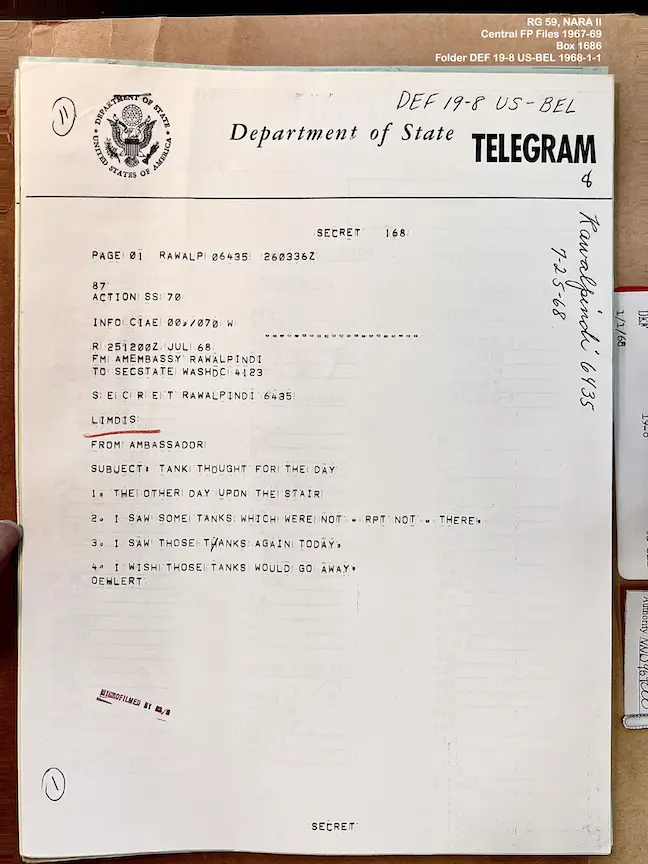
I test this theory through detailed case studies of Soviet-Iraqi relations from 1958 to 1982 and U.S.-Pakistani relations from 1947 to 1970, drawing on multilingual archival research across six countries—including declassified U.S., British, and Iraqi government documents, French diplomatic archives, Soviet memoirs, and Iraqi regime recordings.
One of the key innovations in this research is the concept of “arms curtailment,” which expands the study of arms denial beyond publicly declared embargoes to capture the full spectrum of ways that suppliers prevent transfers from occurring—from slow-walking decisions and refusing export licenses to suspending contracted deliveries or simply turning a deaf ear to a client’s request for consultations. This broader lens provides a more accurate picture of how conventional arms are actually used as instruments of influence in international politics.
Accept No Substitutes: Arms Curtailment and Nuclear Proliferation
As a Stanton Nuclear Security Fellow at RAND, I am extending my research agenda to a question with immediate policy stakes: does the denial of conventional weapons push states toward nuclear proliferation?
For conventional arms to work as a nonproliferation tool—as a substitute for a formal alliance or a security guarantee—the recipient must trust that the supply will continue. But my dissertation research shows that patrons frequently curtail arms to pressure clients, and that clients who have been cut off during wartime are especially likely to conclude that their patron cannot be relied upon. For a state facing the kind of existential threat that drives nuclear ambitions in the first place, the risk that its conventional arms supply could be severed at the worst possible moment may be unacceptable. Nuclear weapons become the ultimate backstop—a capability that cannot be embargoed.
This project addresses two questions:
- Does the experience of arms curtailment affect a state’s willingness to forgo nuclear weapons in exchange for conventional arms—or are such offers likely to fail with states that have been cut off in the past?
- Under what circumstances does arms curtailment increase the propensity to pursue nuclear weapons? Should the United States be concerned that pressuring a partner through arms denial could push that partner toward nuclearization?
I am pursuing two empirical lines of effort. The first is a new dataset capturing episodes of conventional arms curtailment experienced by states considered to be nuclear proliferation risks. No open-source, systematic collection of this data currently exists.
The second is a series of elite interviews with former U.S. policymakers to understand how the government conceptualizes the relationship between conventional arms provision and nonproliferation. Initial conversations suggest an almost total absence of theoretically grounded thinking within the U.S. government about these issues —a gap this project aims to help fill.
The policy implications are direct. If providing conventional weapons only prevents proliferation when the client believes the supply will continue in the face of existential threats, then any patron that has demonstrated a willingness to cut off arms may find its offer insufficient to forestall nuclear ambitions. Furthermore, providing advanced weapons to a state unlikely to be deterred from nuclearization may inadvertently enhance its delivery capabilities. In an era of increasing U.S. willingness to pressure allies and partners through arms curtailment, understanding these dynamics is urgent.
Earlier work
My interest in the politics of the arms trade predates my academic career. In 2011–2013, I wrote extensively on arms transfers, embargoes, and weapons proliferation for The Atlantic, UN Dispatch, and Democracy Journal, covering topics from the proliferation of Libyan weapons after the fall of Qaddafi to the prosecution of Viktor Bout to the global debate over cluster munitions.
Articles from the dissertation and the RAND project are in preparation. Published work in this area can be found on my publications page.